Revolution Clock
Portable word clock with Macro MMC, 4 BNC outs plus S/PDIF, optical, and EAS/EBU outs
US PRICE: $599
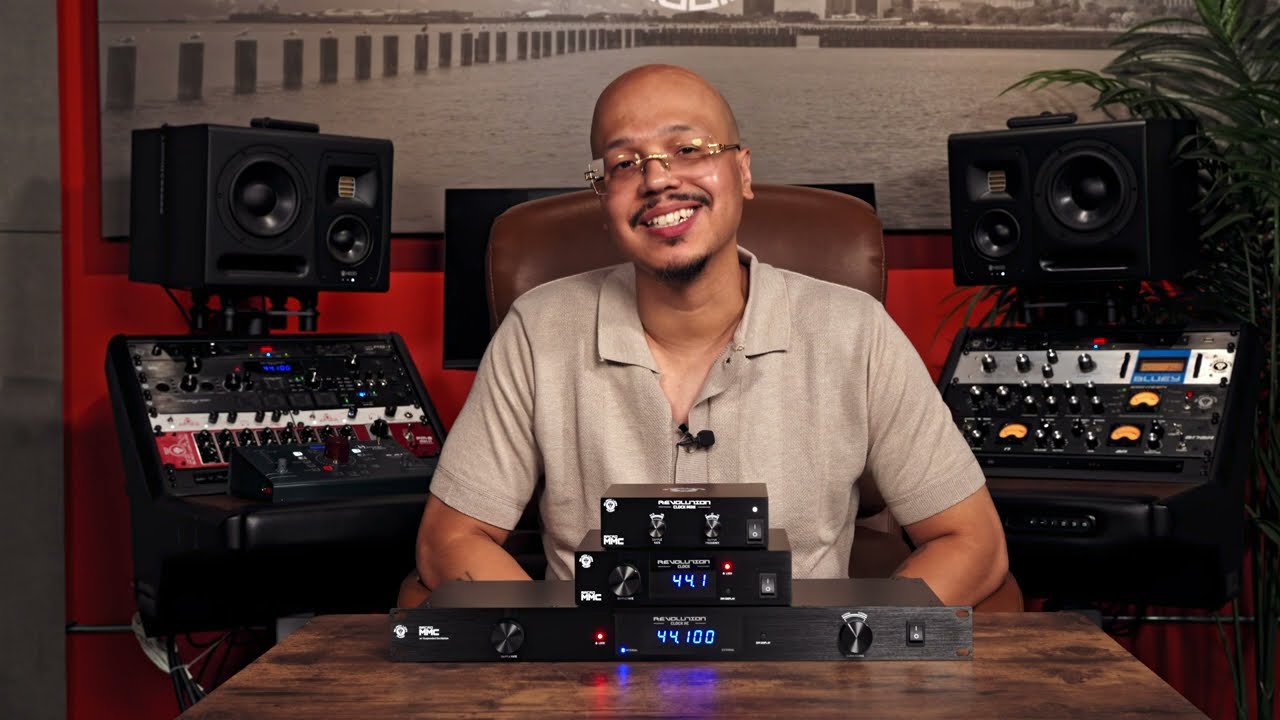
Your music deserves the best.
Revolution Clock delivers rock-solid clocking to keep all of your digital audio devices running in perfect sync over BNC, S/PDIF, optical, and AES/EBU at even the highest sampling rates; 44.1kHz - 384kHz sample rates are supported over BNC.
With only 0.5pS RMS of jitter at the BNC outputs, your devices will be running in perfect sync, and your productions will sound their absolute best.
Once a system is set up and clocked correctly, many users observe a greater sense of space and depth thanks to more accurately-reproduced reverbs and stereo imaging. Some even notice elements of their mixes they didn’t even hear prior to synced clocking!

Why clock?
Short answer: For supreme audio fidelity when using multiple digital audio devices.
Long answer: When running multiple digital audio devices simultaneously without clock sync, clocking jitter can result in smearing of the stereo field, and is particularly noticeable in transients and higher-frequency material like cymbals and lengthy reverb tails.
It’s also worth noting that the effects of superior clocking are cumulative. Noise reduction and jitter may be hard to discern on a two-track recording of vocals and guitar. But if you record a 64-track production through poorly clocked hardware, all that noise and jitter begins to stack up!

Clock nearly anything with superior MEMS Oscillators.
Revolution Clock I/O includes connections for BNC, S/PDIF, ADAT, and AES/ABU. And if you’ve got a device in your studio that accepts clock in, the Revolution Clock can drive it — up to seven devices, four over BNC.
MEMS (Microelectromechanical systems) oscillators won out in both subjective listening tests and objective stability measurements when compared to traditional quartz crystal oscillators. MEMs require no thermal solution for stability as their stability is less affected by temperature. Furthermore, MEMs oscillators enjoy greater shock resistance than quartz crystals.

Patented Macro-MMC.
Macro-MMC is a unique clocking technology developed from our years of experience in creating dedicated word clocks, as well as our interface modification service. Macro-MMC ensures low noise and minimal jitter, accomplished through strict component selection and proprietary methods of signal propagation. We start with a high quality oscillator (timing signal) and apply proprietary methods of signal transfer throughout the unit to keep the quality and accuracy intact all the way up to the output of the device.

Technical
Documentation
Jitter 0.5 pS RMS (BNC outputs)
Outputs 4x BNC, 1x XLR AES, 1x RCA S/PDIF, 1x Optical S/PDIF
Output impedance:
BNC 75 Ω, 5V unterminated
RCA S/PDIF 75 Ω, unbalanced
AES XLR 110 Ω, balanced
Clock frequencies:
BNC (kHz) 44.1, 48, 88.2, 96, 176.4, 192, 352.8, 384
RCA S/PDIF & AES (kHz) 44.1, 48, 88.2, 96, 176.4, 192
Optical S/PDIF (kHz) 44.1, 48, 88.2, 96
Power:
9V DC (6 W power consumption)
Power connector 2.5 mm barrel connector with 5.5mm outer diameter (center pin positive)
Physical:
Width Without rack ears: 17.7 cm (7”)
With rack ears: 48.26 cm (19”)Height 4.45 cm (1.75”)
Depth 16.51 cm (6.5”)
Weight 1.13 kg (2.5 lbs)
1.36kg (3lbs) with rack ears installed

Product Images
Click the image to enlarge.

